
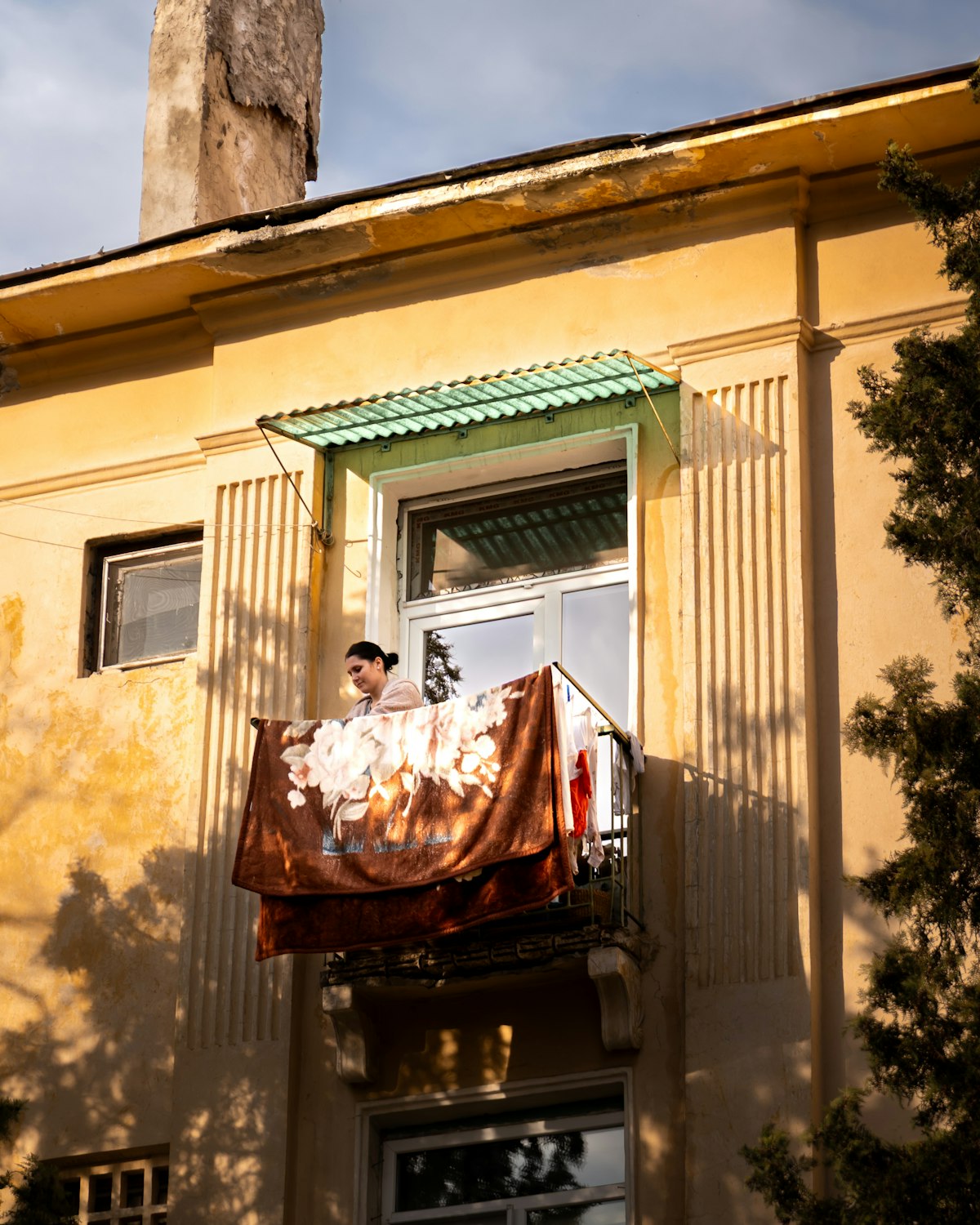
Every Saturday at nine, a woman on the second floor of the yellow building on my corner airs the same blanket over the same railing: brown, with big cream flowers, older than I am. If the weather turns, it stays out anyway. I have started to set my week by it.
I knocked on her door this week. Her name is Dorota, she is seventy-four, and she has lived in that flat since the building had a coal cellar.
A building’s face
“The blanket is for the neighbours,” she told me, and laughed when I asked what she meant. “When it is out, they know I am up. When it is not out by ten, Mrs Kalin from across the street rings.” It is, in other words, a signal. A wordless one, older than any app, and it works.
Planners talk about active frontages: shop windows, doors, balconies, the parts of a building that let the street see that someone is home. They usually mean ground floors and cafés. They rarely mean a blanket. But the principle is the same, and so is the effect: a street that can see into its buildings is a street people look out for.
The new rules
The owners’ association wants to ban laundry and bedding on street-facing balconies. The draft rule talks about “a uniform appearance.” Dorota has read it twice. “Uniform,” she said. “Like a uniform. Who wants to live in a uniform?”
I have some sympathy for the association. Buildings with tidy fronts sell for more, and most of its members are owners, not tenants. But I keep coming back to Mrs Kalin and her phone. A uniform front is a front nobody reads.
When it is not out by ten, Mrs Kalin from across the street rings.
Dorota, second floor
What I would keep
If I could write one line into every building code, it would be this: leave residents a way to show the street they are there. A window box. A bench by the door. A blanket on a railing, on Saturdays at nine.
Supporters: the full interview with Dorota, including the story of the coal cellar, is in the archive under this issue.
Until Tuesday,
Rafael